
Table of Contents
- What Is a Credit Card Statement Balance?
- What Is a Credit Card Current Balance?
- Why Are My Statement Balance and Current Balance Different?
- Credit Card Statement Balance vs. Current Balance: Which Should You Pay?
- What Do I Pay? A Simple Decision Tree
- Illustrative Example
- Common Mistakes Beginners Make
- How This Connects to Credit Utilization
- How to Build a Simple Credit Card Payment System
- Bottom Line
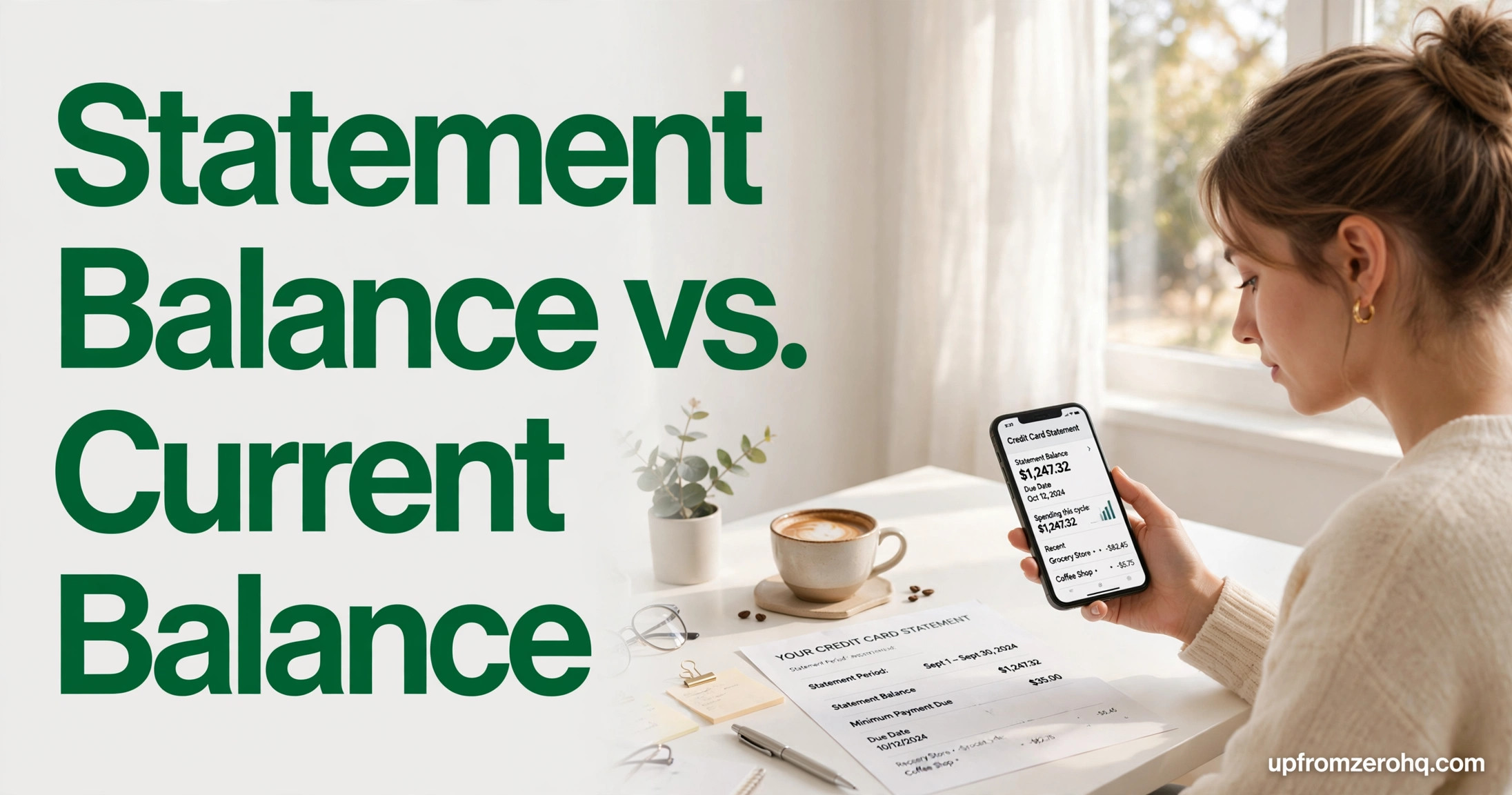
Your credit card app shows two numbers. One says statement balance. Another says current balance. Sometimes they match. Sometimes they do not.
For beginners, this can feel like your credit card company is giving you two different answers to the same question: “How much do I owe?”
The difference is actually simple:
- Your statement balance is the amount shown when your billing cycle ended.
- Your current balance is the amount you owe right now, including newer activity after that statement closed.
Both numbers are useful, but they answer different questions.
The balance you should focus on depends on your goal:
- Trying to avoid interest? Understand your statement balance.
- Trying to know your exact current debt? Look at your current balance.
- Trying to keep your credit card usage lower? You may pay attention to both.
This guide explains exactly what each balance means and gives you a simple decision tree for deciding what to pay.
What Is a Credit Card Statement Balance?
Your statement balance is the amount you owed at the end of your credit card billing cycle. Think of it as a snapshot. Your credit card company takes all the posted transactions, payments, credits, fees, and other activity from that billing period and creates your statement. The balance shown at that point becomes your statement balance.
After the statement is created, that number usually does not change. New purchases after the statement closing date belong to the next billing cycle. For example, if your statement closes on the 15th and you buy something on the 16th, that purchase may appear in your current balance but not your previous statement balance.
This is why your app can show two different numbers at the same time. Your statement balance answers: “How much did I owe when my last billing cycle ended?”
What Is a Credit Card Current Balance?
Your current balance is the amount your credit card account shows that you owe right now. It is a more up-to-date number. It can change as you:
- Make purchases
- Make payments
- Receive refunds or credits
- Accumulate posted fees or charges
Your current balance answers: “How much does my card show that I owe today?”
Because it updates as new activity happens, it may be higher or lower than your statement balance.
A common beginner mistake is assuming the larger number must be the “real” balance. Both numbers are real. They are simply measuring your balance at different points in time.
Why Are My Statement Balance and Current Balance Different?
Your statement balance and current balance are different because your credit card account does not stop moving after your statement closes.
The statement balance is locked to the end of a billing cycle. The current balance continues changing.
Here are common situations:
You used your card after your statement closed Your current balance may be higher because new purchases were added.
You made a payment after your statement closed Your current balance may be lower because you reduced what you owe.
A refund posted after your statement closed Your current balance may decrease even though the original statement balance remains unchanged.
This difference is normal. Seeing two balances does not mean there is an error with your account.
Credit Card Statement Balance vs. Current Balance: Which Should You Pay?
For many people, paying the statement balance in full by the due date is the simplest way to handle a credit card that is being used responsibly.
The statement balance is the amount from your completed billing cycle. Paying more than the statement balance can reduce your current balance faster, but it is not always necessary if your goal is simply paying the completed statement amount.
Your choice depends on your situation.
If you pay your card in full every month Paying the statement balance by the due date is often the easiest system because it matches the bill you received.
If you are carrying credit card debt Paying the current balance may not be realistic. Your priority may be creating a payoff plan and stopping the balance from growing. See: How to get out of debt on a low income (https://upfromzerohq.com/how-to-get-out-of-debt-on-a-low-income/)
If you are trying to manage your credit utilization You may want to pay attention to when balances appear on your credit reports and how much of your available credit is being used. See: What is credit utilization? (https://upfromzerohq.com/what-is-credit-utilization/)
The important thing is not getting trapped by the idea that there is only one “correct” number. The right number depends on what you are trying to accomplish.
What Do I Pay? A Simple Decision Tree
Use this quick decision process.
Step 1: Can you pay the statement balance in full? Yes → Pay the statement balance by the due date. This keeps your payment tied to the completed billing cycle. No → Pay what you can and create a plan to reduce the balance. Avoid ignoring the bill because missed payments can create bigger problems.
Step 2: Are you trying to lower your current balance faster? Yes → Paying more than the statement balance can reduce the amount currently owed. This may help you lower the balance before future purchases or billing activity. No → Paying the statement balance may be enough for your normal monthly system.
Step 3: Are you confused by which number the payment screen shows? Look for labels such as:
- Statement balance
- Current balance
- Minimum payment
- Other amount
Do not choose a number simply because it is the largest or smallest. Know what that payment option represents first.
Illustrative Example
Illustrative example only — these are simple round numbers, not a recommendation or prediction.
A credit card user has:
- Statement balance: $500
- Current balance: $650
Why are they different? The $500 statement balance came from the last completed billing cycle. After that statement closed, the person made another $150 in purchases.
The decision:
- Paying $500 covers the completed statement.
- Paying $650 pays the entire current balance shown today.
The best choice depends on the person’s goal and ability to pay. The example shows why two balances can exist at the same time.
Common Mistakes Beginners Make
Mistake 1: Only Looking at the Current Balance The current balance is useful, but it does not replace understanding your statement. Your statement shows the completed billing period.
Mistake 2: Paying Only the Minimum Without Understanding It The minimum payment keeps the account from being considered late when paid on time, but it may not eliminate the balance. If you cannot pay in full, understand what you owe and create a payoff strategy. See: Pay off debt or save money? (https://upfromzerohq.com/pay-off-debt-or-save-money/)
Mistake 3: Thinking a Different Balance Means the App Is Wrong Two balances can be correct. They are usually showing different time periods.
Mistake 4: Forgetting New Purchases After the Statement Date A purchase made after your statement closes may not appear on that statement. It can still appear in your current balance.
Mistake 5: Ignoring Your Credit Card Statement Your statement contains important information:
- Transactions
- Payments
- Fees
- Due dates
- Balances
Do not rely only on the app home screen.
How This Connects to Credit Utilization
Credit utilization is the relationship between your credit card balances and your available credit. A lower utilization rate is generally viewed as better for credit scoring models, although scoring models consider multiple factors.
Your reported balance can matter because credit reporting typically uses information supplied by lenders, often based on a statement-period balance.
That does not mean you need to constantly pay your card every day. For most beginners, the bigger priorities are:
- Pay on time.
- Avoid carrying more debt than you can manage.
- Keep spending within your budget.
If you are building credit from scratch, see: How to build credit from scratch (https://upfromzerohq.com/how-to-build-credit-from-scratch/)
How to Build a Simple Credit Card Payment System
A good system is usually better than constantly checking balances. Try this:
- Pick a payment routine — Choose a day each month to review your card.
- Check your statement balance — Know what the completed billing cycle says you owe.
- Check your budget — Make sure the payment fits your actual available money. Use: Budget calculator (https://upfromzerohq.com/budget-calculator/)
- Pay intentionally — Know whether you are paying the statement balance, current balance, or another amount.
- Repeat — Consistency matters more than constantly changing strategies.
Bottom Line
Your credit card statement balance and current balance are not competing numbers. They represent two different views of your account. The statement balance shows what you owed when your billing cycle ended. The current balance shows what you owe based on your latest account activity.
For many beginners, the simplest approach is understanding your statement balance, paying on time, and avoiding spending more than you can afford.
Once you understand the difference, the confusing numbers in your credit card app become much easier to manage.
This article is general educational information, not personalized financial, credit, legal, or tax advice. Credit card terms, billing practices, and reporting methods can vary by issuer. Review your own credit card agreement and account information for details specific to your situation.
Free Download
Get the From-Zero Money Reset — free
A simple one-page worksheet to find your breathing room, set up your 3 buckets, and automate one thing — in 10 minutes flat. Enter your email and I will send it immediately.
No spam. Unsubscribe any time. Plain-English money tips only.