
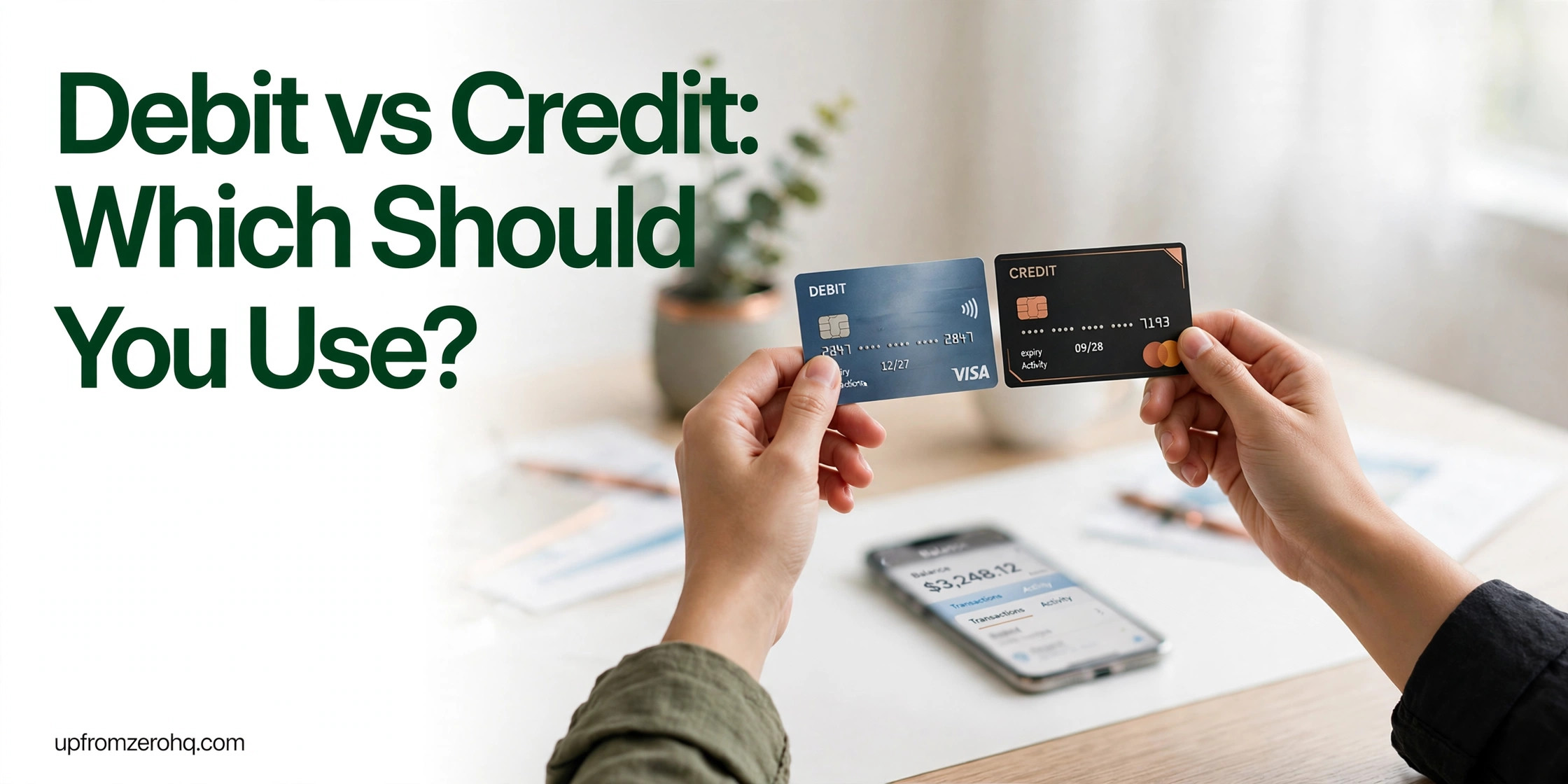
SEO title: Debit Card vs Credit Card: Which Should Beginners Use?
Meta description: Learn the real difference between debit cards and credit cards, when to use each, and beginner mistakes to avoid.
General educational information only. This is not financial advice. Money decisions depend on your personal situation, goals, and circumstances.
A debit card and a credit card look almost identical. They both have a card number, expiration date, and security code. Both can usually be used online, in stores, and through digital wallets. New to credit entirely? Start with how to build credit from scratch.
The biggest difference is what happens behind the scenes.
A debit card uses money you already have.
A credit card uses money you borrow and pay back later.
Neither card is automatically “good” or “bad.” The right choice depends on how you manage money, what you are buying, and what habits you are trying to build.
For many beginners, the best answer is not choosing one forever. It is understanding when each tool makes sense.
Table of Contents
How a debit card works
A debit card is connected directly to your checking account.
When you use it, money comes from your own account instead of being borrowed.
Think of it like spending cash that happens to be stored digitally.
For example:
- You have money in your checking account.
- You use your debit card to buy something.
- The purchase is authorized.
- The money is removed from your available balance.
A debit card can be useful because it naturally limits spending. If you only spend money that is already in your account, you are not creating credit card debt.
However, debit cards have a few things beginners should understand.
Authorization holds can temporarily reduce available money
Sometimes a merchant does not immediately complete the final transaction amount.
Instead, the merchant places an authorization hold.
An authorization hold is a temporary reservation of money that tells the bank, “this amount may be needed for this purchase.”
The final charge may happen later.
This matters because a hold can make your available balance look lower than expected until the transaction finishes.
Common situations where holds may happen include:
- Hotels
- Rental cars
- Fuel stations
- Restaurants
- Other businesses where the final amount may change
A beginner who is watching every dollar in their checking account can accidentally think they have more money available than they actually do.
A debit card is still using your own money, but timing matters.
How a credit card works
A credit card works differently.
Instead of pulling money directly from your checking account, the card issuer gives you a borrowing limit.
You make purchases using that available credit, then receive a statement showing what you owe.
A simple credit card cycle looks like this:
- You make purchases.
- Those purchases appear on your statement.
- You receive a payment due date.
- You pay what you owe.
Credit cards can be useful because they can help build credit history when managed responsibly.
They can also create problems when someone treats the credit limit like extra income.
A credit limit is not money you earned.
It is money you can borrow.
The safest beginner approach is usually simple:
Only charge purchases you already have the money to pay for.
Fraud protections: debit vs credit
One of the biggest differences between debit and credit cards is how unauthorized transactions are handled.
Debit cards are generally covered by federal electronic fund transfer protections under Regulation E.
Credit cards have protections under federal credit card rules, including the Fair Credit Billing Act.
The details can depend on the situation and how quickly you report the problem.
Debit card protections
For certain unauthorized debit transactions, federal rules include different levels of potential responsibility depending on when you notify your bank or credit union.
The CFPB explains that if you report a lost or stolen debit card within two business days after discovering the loss, your responsibility generally cannot exceed $50. If you report later than two business days, responsibility may increase to $500. If an unauthorized transaction appears on a statement, reporting within 60 days is important.
The key beginner lesson:
A debit card is connected to your actual bank balance. If money leaves your account because of fraud, the issue is tied to money you already had.
Credit card protections
Credit cards have different protections.
The CFPB explains that for unauthorized credit card use, federal law limits responsibility to $50 in certain circumstances, and if the card itself was not lost but only the account number was stolen, consumers generally have no liability for unauthorized use.
The practical difference:
With a debit card, the money may leave your account first while the issue is investigated.
With a credit card, the disputed amount is generally part of a credit account balance rather than money already removed from your checking account.
That does not mean credit cards are risk-free. Fraud should always be reported quickly.
When should a beginner use a debit card?
A debit card can be a good choice when the goal is controlling spending.
Situations where debit may make sense:
You are learning basic money management
If you are building your first budget, using money you already have can make spending easier to understand.
Your checking account balance is your limit.
You struggle with impulse spending
A credit card can make spending feel disconnected from reality.
A debit card creates a closer connection between buying something and seeing your bank balance change.
You are rebuilding your financial habits
Some people benefit from removing the temptation to borrow.
Debit can be a simple way to practice living within your available cash flow.
When should a beginner use a credit card?
A credit card can make sense when you have strong money habits.
Situations where credit may be useful:
You can pay the statement balance
The biggest beginner rule:
Do not buy something with a credit card unless you already have a plan to pay for it.
A credit card is a payment tool, not a replacement for income.
You want to build credit history
Responsible credit card use can help establish a record of borrowing and repayment.
That history can matter later when applying for financial products.
You want an extra layer between purchases and your bank account
Some people prefer using credit for everyday purchases because unauthorized activity is not directly pulling money from their checking account balance.
Illustrative example
Illustrative example only: Imagine someone has a simple budget with 100 units available for spending.
They use a debit card and spend 30 units on planned purchases. Their checking account reflects that money leaving.
Someone else uses a credit card for the same 30 units of purchases but already has those 30 units set aside in their budget. When the statement arrives, they pay the balance from money they already planned to use.
The difference is not the purchase itself. The difference is whether the person is using a card as a payment method or using it to spend money they do not have.
These simple numbers are only an illustration, not a recommendation or prediction of actual spending.
Beginner mistakes to avoid
Mistake #1: Treating a credit limit as income
A credit limit can make your bank account look healthier than it really is.
If you spend borrowed money and cannot repay it, the problem appears later.
Mistake #2: Ignoring debit card overdrafts
A debit card does not always guarantee that spending stops exactly when your balance reaches zero.
Depending on your account setup and transaction type, overdrafts may create problems.
Understanding your account rules matters.
Related: Opting out of overdraft protection (and the fee you’d rather never pay)
Mistake #3: Forgetting about pending holds
A checking account balance is not always the same thing as money available to spend.
Pending transactions and authorization holds can temporarily affect what you can use.
Mistake #4: Using credit cards without a repayment system
A credit card works best when you have a system:
- Track purchases
- Know your spending limit
- Pay on time
- Avoid buying things you cannot afford
Related: How to create a budget for the first time
Debit card vs credit card: a simple comparison
| | Debit Card | Credit Card |
|—|—|—|
| Money source | Your checking account | Borrowed money |
| Monthly statement | Usually no | Yes |
| Builds credit history | Usually no | Yes |
| Risk of overspending | Lower for many people | Higher if unmanaged |
| Fraud situation | Connected to your bank funds | Connected to a credit account |
| Best beginner use | Spending within your available money | Building credit with discipline |
The simple rule to remember
For beginners, the best card is usually the one that helps you build good habits.
Use debit when your priority is controlling spending and staying within the money you already have.
Use credit when you can treat it like a debit card, meaning you only spend money you already have and pay what you owe.
The card itself is not what determines your financial health.
The habit behind the card is what matters.
Before choosing a card, make sure your bigger money system is working:
- Know where your money goes.
- Keep bills organized.
- Build an emergency buffer.
- Avoid spending more than you earn.
Related:
- How to stop living paycheck to paycheck
- How to build an emergency fund
- How to create a budget for the first time
- How to catch up on bills when you’re behind
- Bank vs credit union: what is the difference?
- What is a money market account?
- Best budgeting apps for beginners
- How to cancel subscriptions and stop wasting money
Free Download
Get the From-Zero Money Reset — free
A simple one-page worksheet to find your breathing room, set up your 3 buckets, and automate one thing — in 10 minutes flat. Enter your email and I will send it immediately.
No spam. Unsubscribe any time. Plain-English money tips only.