
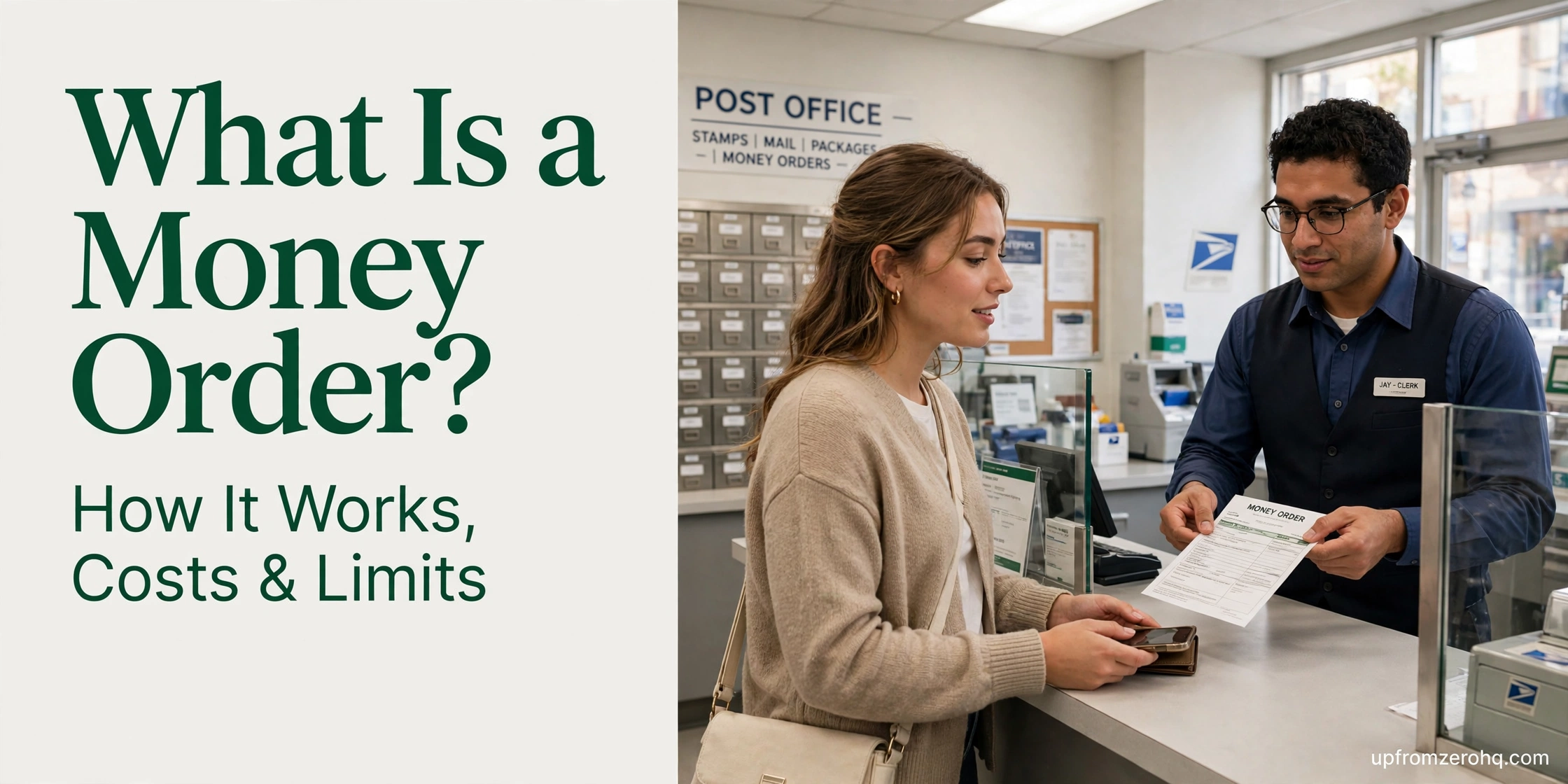
A money order is a prepaid paper payment. You pay the full amount up front, plus a small issuing fee, and you get a paper instrument made out for that amount. The U.S. Postal Service (USPS) presents its postal money order as an alternative to sending cash or a personal check by mail. A single USPS money order can be for up to $1,000 (as of October 13, 2026, usps.com). USPS money order fees as of October 13, 2026 (usps.com): $2.65 for $0.01 to $500.00, and $3.75 for $500.01 to $1,000.00. Keep the receipt: it is your tracking record and your proof of value if the order is lost, stolen, or damaged.
Table of Contents
- Watch: the idea in video form
- What is a money order?
- Money order vs. cashier’s check vs. wire transfer vs. cash
- What does a money order cost? (USPS figures only)
- Where to buy a money order
- How to fill out a money order, step by step (USPS)
- How to cash or deposit a money order
- Lost or stolen: replacing a USPS money order
- Money order scams: read this before you deposit one
- Who should use a money order?
- Frequently asked questions
- Sources
Watch: the idea in video form
What is a money order?
A money order is a payment you buy before you send it. That prepaid step is the whole mechanic, and it is the safest way to understand the product.
Here is how a USPS money order purchase works, in order:
- You decide the amount.
- You go to a Post Office location.
- You pay the dollar value of the order, plus an issuing fee. At USPS, payment is by cash or debit card; USPS states a credit card cannot be used.
- You fill out the money order at the counter with a retail associate.
- You keep your receipt.
Because the money is paid in full before the instrument exists, a money order is different from a personal check, which is an order drawn on the writer’s own bank account. USPS frames its postal money order as the mail alternative to sending cash or a personal check.
One legal nuance, in a single line: the Uniform Commercial Code can treat some instruments described as a “money order” as a type of check, depending on the instrument’s own terms. That is a legal classification point, not the everyday definition, and it does not mean every money order is legally a check.
Do not confuse a money order with a money market account. They are unrelated products that happen to share a word: a money order is a payment instrument, while a money market account is a deposit account. If the account is what you are researching, see our guide to what a money market account is.
Money order vs. cashier’s check vs. wire transfer vs. cash
Money order vs. personal check
A personal check is drawn on the writer’s own account. A money order is prepaid: the buyer pays the face value plus the fee at the counter, before the order is issued. USPS presents its postal money order as an alternative to sending a personal check by mail.
Money order vs. cashier’s check
Under the Uniform Commercial Code, a cashier’s check is a draft where the drawer and the drawee are the same bank. The verified sources for this guide do not give an equivalent one-line legal definition of “money order” as an issuer class, so this guide describes money orders by verified example instead: the Postal Service issues postal money orders, and the FDIC lists money orders among the official items issued by a bank. In plain terms, both products are prepaid paper payments; who issues the instrument is the practical difference a beginner can rely on.
Money order vs. wire transfer
This guide’s verified sources cover paper payments, and they do not source wire transfer fees, speeds, or limits, so no wire figures are stated here. One sourced point does apply to both: in the Federal Trade Commission’s scam guidance, money sent by wire transfer, like money sent by gift card or money order at a scammer’s direction, is treated as like cash and almost impossible to recover. If a payment decision depends on wire costs or timing, verify them with the provider before you send anything.
Money order vs. cash in the mail
USPS presents its money order as the safer alternative to sending cash by mail. Two verified mechanics support that framing for a USPS money order: the receipt lets you track the payment and show proof of value, and a lost or stolen USPS money order has a replacement path (with a fee and a waiting period — see “Lost or stolen” below). This guide’s sources make no claim about recovering cash sent by mail, so no comparison is stated on that point.
For a broader look at how everyday payment methods differ, see our comparison of debit cards vs. credit cards and our guide to banks vs. credit unions.
What does a money order cost? (USPS figures only)
Every figure in this section is a USPS figure, verified on usps.com. Fees and limits at other issuers are not stated in this guide, because they were not verified on the issuers’ own sites for this draft. See the verification log at the end of this file.
USPS money order fees, as of October 13, 2026 (usps.com). USPS bases the fee on the dollar amount of the order:
- USPS money order of $0.01 to $500.00: $2.65 fee.
- USPS money order of $500.01 to $1,000.00: $3.75 fee.
- Postal military money orders, issued by military facilities: $0.85 fee.
USPS single-order limit, as of October 13, 2026 (usps.com): you can send up to $1,000 in a single domestic USPS money order, anywhere in the United States. That $1,000 limit is a USPS limit for a USPS money order. This guide does not state it as a universal limit for money orders from other issuers, because no other issuer’s limit was verified for this draft.
What about fees somewhere else? Banks, retailers, and money transmitters also sell money orders, but their fees and limits vary and were not verified on their own sites for this draft, so no figures for them appear here. If you buy anywhere other than a Post Office, ask for the fee and the per-order limit at the counter before you pay.
Worked example, USPS only: to send $300 by USPS money order as of October 13, 2026 (usps.com), you would pay $300 plus the $2.65 USPS fee, for $302.65 total, at the counter, in cash or by debit card.
Where to buy a money order
Verified for this guide:
- Any Post Office location. USPS states you can buy or cash postal money orders at any Post Office location, and the purchase steps above are the USPS counter process.
- A bank. The FDIC lists money orders among the official items issued by a bank. This guide does not state any bank’s fee, limit, or account requirement, because none was verified for this draft.
Other sellers exist, but their fees, limits, and requirements are flagged in this draft’s verification log as varying and not published here. Wherever you buy, confirm the fee and the limit before you hand over payment, and keep the receipt either way.
How to fill out a money order, step by step (USPS)
The verified USPS process, in the order USPS gives it:
- Decide on the money order amount. For a USPS money order, the amount can be up to $1,000 in a single order (as of October 13, 2026, usps.com).
- Go to any Post Office location.
- Take cash or a debit card. USPS states you cannot pay with a credit card.
- Fill out the money order at the counter with a retail associate. USPS describes the form being completed at the counter as part of the purchase.
- Pay the dollar value of the money order plus the USPS issuing fee.
- Keep your receipt to track the money order. The receipt is also your proof of value if the order is lost, stolen, or damaged.
A note on scope: this guide does not give field-by-field form instructions (which line takes which name or address), because the primary sources verified for this draft do not publish a field list. The counter process above is the verified process. If you are unsure about any entry while you are at the counter, ask the retail associate before you complete the purchase — that is what the counter step is for.
How to cash or deposit a money order
Cashing a USPS money order, per USPS:
- A USPS money order can be cashed at a Post Office for free.
- Do not sign the order beforehand. Bring a primary photo ID, and sign at the counter in front of a retail associate.
- A USPS money order can also be cashed at most banks and some stores. Rural carriers may cash one if they have enough money on hand.
- A domestic USPS money order never expires, does not accrue interest, and is cashed for the exact amount on the order. That “never expires” point is a USPS rule for domestic USPS money orders; this guide does not extend it to other issuers.
Depositing, and a warning that matters: for new bank accounts, the Office of the Comptroller of the Currency (OCC), summarising Regulation CC, lists postal money orders among the items where amounts up to $6,725 deposited in one day are generally available in one or two business days after the banking day of deposit, with the excess possibly held until the ninth business day, and the bank may require a special deposit slip. That statement is only about new accounts and only about postal money orders. It is not a general promise about when any money order clears — and funds being made available is not proof that an item is genuine. If a deposited money order later turns out to be fraudulent, the bank can reverse the funds, and the person who deposited it can be responsible for the amount. Read the scams section below before you deposit a money order from anyone you do not know.
If you are behind on regular bills and deciding which payment method a landlord or utility will accept, see our guide to catching up on bills when you are behind.
Lost or stolen: replacing a USPS money order
USPS states payment cannot be stopped on a postal money order. There is no stop-payment option. What exists instead is a replacement path for a lost or stolen USPS money order, and it has a cost and a wait. Both are part of the fact, and this guide always states them together:
- Replacement processing fee stated by USPS: $23.00 (as of the brief verification, October 13, 2026, usps.com; see the verification log for re-verification status).
- Confirming the loss or theft may take up to 30 days, and investigating it may take up to 60 days (USPS, as verified in the source brief, October 13, 2026).
- The buyer starts a Money Order Inquiry at a Post Office, with the receipt.
- Status can then be checked online. A status check requires the serial number, the Post Office number, and the dollar amount.
Practical takeaway: keep the receipt separate from the money order itself. Without it, you do not have the tracking record the inquiry starts from.
Money order scams: read this before you deposit one
A genuine USPS money order is the mail-safer instrument USPS describes. A money order you receive can still be counterfeit. Both halves are true, and the second half is where beginners lose money.
The overpayment scam (Consumer Financial Protection Bureau). A supposed buyer sends a counterfeit money order, or a bad check, for more than the price of the item you are selling, and asks you to send back the difference. The CFPB’s advice: do not send any money to the buyer. Alert your bank or credit union and the marketplace. If a counterfeit item is deposited, the depositor receives no funds — or, if funds were credited, must pay them back even after withdrawing them.
The deposit-and-send scam (Federal Trade Commission). If anyone tells you to deposit a check, withdraw money, and send it to someone, that is a scam. The FTC gives the same warning to students directly: never use money from a check to send gift cards, money orders, or a wire to someone who asks. Banks must make deposited funds available within a few days, but a fake can surface later, and the bank takes the money back.
Who pays when a fake is deposited (OCC). If a bank credited an account for a check or money order later found fraudulent, it can reverse the funds. The depositor may be held responsible for the amount cashed or deposited, and getting the money back means pursuing the person who paid with the fraudulent item. A bank may also freeze a transaction or close an account for fraudulent activity. Your deposit account agreement governs your bank’s specific policy.
How to spot a fake USPS money order (USPS): – A domestic USPS money order cannot exceed $1,000. An order showing more than that is not a genuine domestic USPS order. – The words and the numbers for the amount should match. – Discoloration or paper disturbance around the amount may indicate alteration. – A watermark that is easily visible without holding the order to the light may indicate fraud.
Verification routes given by USPS: the online money-order tool / QR code; the Money Order Verification System at 1-866-459-7822; and, for suspected fraud, the U.S. Postal Inspection Service at 1-877-876-2455. The FTC also routes scam reports to ReportFraud.ftc.gov.
Rule of thumb that follows from the sources above: if a money order arrives for more than you were owed, or you are asked to deposit one and pass money on to someone else, stop. Verify first, using the routes above, and send nothing.
Who should use a money order?
Based only on the verified mechanics in this guide, a USPS money order fits situations like these (this paragraph is practical inference from the sourced mechanics, labelled as such, not a sourced claim):
- You need to mail a payment and do not want to mail cash or a personal check. USPS positions its postal money order for exactly that use, and the receipt gives you a tracking record cash does not come with in these sources.
- The amount is $1,000 or less and you can pay at the counter in cash or by debit card. Those are the USPS terms verified above.
- The person or business you are paying asks for a money order, or accepts one, and you want a paper record of the payment amount and purchase.
A money order is a poor fit when the amount is above the issuer’s per-order limit, when you need a stop-payment option (USPS states payment cannot be stopped on a postal money order), or when the payment is urgent in a way a mailed paper instrument cannot meet. This guide states no delivery-speed figures, because none were verified in its sources.
One more coverage note, stated precisely because it is easy to get wrong: the FDIC lists money orders among the official items issued by a bank that are covered deposit products at an FDIC-insured bank, alongside cashier’s checks, with the standard insurance amount of $250,000 per depositor, per insured bank, per ownership category. That coverage statement is for bank-issued items at insured banks. It does not make a USPS or retailer-issued money order an FDIC-insured deposit, and this guide never describes money orders in general as FDIC-insured.
Frequently asked questions
What is a money order, in one sentence?
A money order is a prepaid paper payment: you pay the full amount plus an issuing fee up front, and the instrument is then payable for the amount printed on it.
How much does a USPS money order cost?
As of October 13, 2026 (usps.com), the USPS fee is $2.65 for a USPS money order of $0.01 to $500.00, and $3.75 for $500.01 to $1,000.00. A postal military money order, issued by a military facility, carries a $0.85 USPS fee. Fees at other issuers vary and are not stated in this guide.
What is the maximum amount for a money order?
For USPS, up to $1,000 in a single domestic USPS money order (as of October 13, 2026, usps.com). That is a USPS limit. This guide does not state a universal limit for other issuers, because none was verified for this draft.
Can you pay for a USPS money order with a credit card?
No. USPS states payment is by cash or debit card, and a credit card cannot be used.
Do money orders expire?
A domestic USPS money order never expires, does not accrue interest, and is cashed for the exact amount on the order (USPS). This guide states no expiry rule for other issuers.
Can you stop payment on a money order?
For a USPS money order, no. USPS states payment cannot be stopped on a postal money order. A lost or stolen USPS money order can be replaced instead; see the next answer.
What happens if a money order is lost or stolen?
For a USPS money order: start a Money Order Inquiry at a Post Office with your receipt. The USPS replacement processing fee is $23.00. Confirming the loss or theft may take up to 30 days and investigating it up to 60 days. You can check status online with the serial number, the Post Office number, and the dollar amount.
Where can you cash a money order?
A USPS money order can be cashed at a Post Office for free — do not sign it beforehand; bring a primary photo ID and sign at the counter in front of a retail associate. USPS also states its orders can be cashed at most banks and some stores, and rural carriers may cash one if they have enough money on hand.
Is a money order the same as a cashier’s check?
No. A cashier’s check is defined in the Uniform Commercial Code as a draft where the drawer and the drawee are the same bank. A money order is described in this guide by its verified issuers and mechanics — prepaid at a counter, for example at a Post Office — rather than by a single legal issuer definition.
What if someone sends you a money order for too much money?
Treat it as a scam warning sign. The CFPB describes exactly this overpayment pattern with counterfeit money orders: do not send any money back, alert your bank or credit union and the marketplace, and verify the order first using the USPS routes in the scams section above.
Schema note for the publishing gate: mark up the FAQ above as FAQPage structured data at publish time, using the question-and-answer text verbatim from this section. Do not add questions or answers at the gate without re-verifying them against the sources box below.
Sources
Primary sources only, as opened and read for the source brief (UFZ-20261012-329, 2026-10-13) and re-checked as noted in the verification log:
- USPS, Money Orders: https://www.usps.com/shop/money-orders.htm
- CFPB, Ask CFPB — overpayment / counterfeit money order question (last reviewed April 15, 2024): https://www.consumerfinance.gov/ask-cfpb/someone-bought-something-i-was-selling-online-and-sent-me-a-check-or-money-order-for-more-than-the-price-of-the-item-they-asked-me-to-send-back-the-difference-should-i-be-worried-en-997/
- FTC, Consumer Advice — fake offers for secret shopper jobs (2020): https://www.consumer.ftc.gov/consumer-alerts/2020/03/fake-offers-secret-shopper-jobs
- FTC, Consumer Advice — college student scam alert (2020): https://www.consumer.ftc.gov/consumer-alerts/2020/12/hey-college-students-have-you-seen-scam
- OCC / HelpWithMyBank, fraudulent checks and money orders (last reviewed October 2025): https://www.helpwithmybank.gov/help-topics/fraud-scams/fraud/check-fraud/fraud-closed.html
- OCC / HelpWithMyBank, funds availability — new accounts (last reviewed June 2025): https://www.helpwithmybank.gov/help-topics/bank-accounts/funds-availability/funds-availability-new-account.html
- OCC, Check Fraud: https://www.occ.gov/topics/consumers-and-communities/consumer-protection/fraud-resources/check-fraud.html
- FDIC, Deposit Insurance At A Glance: https://www.fdic.gov/resources/deposit-insurance/brochures/deposits-at-a-glance
- Uniform Commercial Code 3-104, read via Cornell LII as conduit (the UCC is the source; Cornell is not): https://www.law.cornell.edu/ucc/3/3-104
This article is educational information only. It is not financial advice, and Up From Zero is not a financial advisor. Fees, limits, and procedures change; verify current figures with the issuer — for USPS money orders, at usps.com — before you buy, cash, or deposit a money order. If you suspect fraud, use the USPS and FTC reporting routes listed in the scams section.
Free Download
Get the From-Zero Money Reset — free
A simple one-page worksheet to find your breathing room, set up your 3 buckets, and automate one thing — in 10 minutes flat. Enter your email and I will send it immediately.
No spam. Unsubscribe any time. Plain-English money tips only.